Translate

Monday, April 17, 2017

Cascade River State Park

One week ago, I got the last minute opportunity to host a Monday Night Mix show at the radio station.  I enjoy doing that show from time to time, because it gives me the opportunity to play the music that does not necessarily fit into my other shows.  That includes things such as the small amount of modern Country I have, as well as the a-capella music in my collection.  When I first did one of those shows eight years ago, I asked about the criteria for the show, and was basically told not to play any cuss words.  One of my favorite things about North Shore Community Radio, is that we are able to play the music that we want to play.

I came down the Gunflint Trail much earlier in the day, and had some time to go to the local library, run a few errands, and take a trek down to the Cascade River State Park.  The spring is a great time to see the many waterfalls in that park, as well as along the North Shore of Lake Superior.

I parked my car by Highway 61, and trekked inland.  One of the first sights I came across was the largest of the waterfalls, known as Cascade Falls.

The path then went past the upper part of the falls, and I got a great view of the water flowing over the precipice.  Seeing a sight like this really reinforces how incredibly powerful water can be.

The path followed the river gorge for a while until it came to the beautiful series of waterfalls known as the Cascades.  There was an interpretive sign there that explained how the root beer color of the water was not due to pollution, but a combination of humic acid (formed by decaying organic matter in swamps and bogs), and the natural iron in the water.  The foam was from the aeration of the water from the waterfalls and rapids.  According to the sign, there is no development along the entire seventeen miles of the Cascade River.

I continued to hike up the trail for a while, and eventually came to a sign for the Superior Hiking Trail, which brought back some great memories from my college days.


In the spring and summer of 1999, I participated in a program at Wolf Ridge Environmental Learning Center called Superior Studies.  The students and professors of the program were from Concordia College-Moorhead (my alma mater), St. Olaf, St. Thomas, St. Johns, Gustavus, and St. Benedict.  We got together on the North Shore of Lake Superior to take college courses, and do Environmental Studies in the field.  The program really cemented my love of the Arrowhead region of Minnesota, and is probably a big part of the reason I now work on the Gunflint Trail as a Naturalist.  Sadly, the Superior Studies program no longer exists.

We started Superior Studies with an extended wilderness journey, and had the option of other trips each weekend of the program.  Our options were backpacking, canoeing, and kayaking.  Over the course of the program, I did all three, but started out with a backpacking trip from the Cascade River State Park to the Temperance River State Park.

During the trip, we all acquired nicknames because of the things we did.  Our leader was Hot Tang because he liked to heat up the powdered Tang drinks.  There was Map Girl, since she was constantly looking at the map.  G.I. Joe wore camouflage, and Hollywood wore sunglasses that made her look a movie star.  Birch Bark Girl gathered the birch bark for the fires, and Flint lit a fire with his flint and steel.  When you see me around, you can ask which nickname was mine.

It was a great trip, and I discovered many of my favorite sights along the North Shore of Lake Superior, including: the Temperance River State Park, Oberg Mountain, and the Cascade River State Park.  To this day, I still visit many of those places, along with other stretches of the Superior Hiking Trail.

After hiking a little further up the trail, I turned back, and crossed a bridge to the other side of the river, which I followed back to Highway 61 and the shore of Lake Superior.  Stopping at my car, I picked of my picnic dinner, and walked down to the spot where the Cascade River meets Lake Superior.  There was a loud roar as the water rushed under the bridge and slammed into the 3 quadrillion gallon Lake Superior.  Giant water hay stacks rose above the surface of lake, as waves crashed into the shore.


Friday, April 14, 2017

Ice Out and Other Signs of Spring


Gunflint Lake
 I went for some nice walks today to look for signs of spring.  The biggest signs were the open water in Lonely Lake, and the very dark ice on Gunflint Lake.  When the ice turns very dark (almost black), it means ice-out is soon.  I'm really looking forward to the progression of spring, when we see more green plants, flowers, returning birds, awakening animals, and open water.


Lonely Lake
I have also seen the return of many types of birds.  The Red-winged Blackbird, the Common Grackle, the Chipping Sparrow, the American Robin, and the Mallard Duck are just a few examples of what I saw today.

Many of the hibernating animals are also getting up.  There has been a reliable sighting of a black bear, and I have seen both the Eastern Chipmunk, and the Least Chipmunk.  The Red Squirrels also seem to be establishing their territories for the summer.

The first Mallard (Anas platyrhynchos) on Gunflint Lake.


This Least Chipmunk (Tamias minimus) is awake after a winter of semi-hibernation.
It is the smaller, but more carnivorous of the two species of chipmunks in the area. 

This Red Squirrel (Tamiasciurus hudsonicus) was awake the whole winter, but seems ready for spring!

Monday, April 10, 2017

Before the Radio Show...

I try to arrive at the station an hour in advance for my radio shows.  That gives me plenty of time to get my music ready, complete all the pre-show procedures, and get the proper mindset for the show.  If I were to arrive very shortly before the show, everything would feel rushed, and that would translate into the listening experience.


The first thing I do upon arrival at WTIP is to bring in my collection of music.  I have a combination of compact disks, long play records, and digital recordings that I use on the air.  I have used cassette tapes in the past, but find that can be way too time consuming for the middle of the show.

My Dad and I made boxes for my compact disc collection.  They work a lot better than the plastic bins I used to use.  We made them so I could lay them on the floor, and prop the hinged tops against the wall.  I organize the artists alphabetically, and the compilations by genre.  It is extremely important to keep everything organized for the show, as I don't want dead air while I am searching for a recording.

These are the CD boxes my Dad and I made.
The one on the left is all individual artists,
and the one on the right includes individual artists and compilations.
I can also pull music from the station library.  When I do the Polka Time show, I use a lot of music from the library, and some of my own.  For Classic Country, I use mostly my own collection, and some of the library recordings.  When I do the Thirsty Boots, Women in Music, or Monday Night Mix shows, I pretty much exclusively use my own music.
WTIP Music Library

Going into a show, I know what many of the songs will be in my music sets.  Prior to arriving at the station, I will preview new music, and write down ideas for sets.

During a show, I know how much time I want to spend on a particular genre.  For instance, during Thirsty Boots, I might play an hour of Celtic Music, twenty minutes of Bluegrass, and forty minutes of American and Canadian Folk Music.    The genres and individual music depends on my mood, or cultural holidays.  Many great hosts plan out every bit of their show in advance, but I like to leave a little bit of wiggle room for requests, and other unforseen circumstances.  The nice thing about community radio is that you get to hear a wide variety of host styles (and music) so there is literally something for everyone.

The next thing I do is to turn on all the CD players, and the record player.  If the previous show is coming out of the other broadcast studio, I will do a microphone check at this time.   I also look over the sound board to make sure all the correct buttons are lit up. 

We have two main broadcast studios (A and B), and two production studios (C and D).  I broadcast most of my shows out of the smaller Studio B, since it provides a more intimate atmosphere.  When I have live music during my show (usually during a pledge drive), I will go out of Studio A.
Studio B

Studio A
I next pull up the weather for the Grand Marais, and inland areas (like the Gunflint Trail).  It is important to reference both places, since, due to the massive influence of Lake Superior, the weather can be different.  Over the years, I have fluctuated on the amount of detail to be included in my forecast.  I have settled on printing out the Grand Marais forecast, and writing in the differences for the inland areas.  Then I read weather for the night of the show, and the following two days.  When talking about the night of the show and the following day, I go over temperatures, wind, and precipitation.  The last day of the forecast (the least accurate day), I just mention the temperature and precipitation, but leave out the wind.  If the temperatures for the two areas are close, I average them out.

I'll also note what the temperatures are around the region.  If the readings are similar from Duluth to Thunder Bay, I will say that the temperatures on the North Shore are ...., and the temperatures in the inland areas are .....  I could list every town along the way, but I would rather play an extra song, since people are tuning in to my shows for the music.  Each host is a little different in their forecasting style, which is a good thing, because it keeps everything fresh.

The next thing I do is to bring up our pre-recorded promos on the computer, and pull out the underwriter cards..  We are given a specific list of promos and underwriter cards to read during a given show, and we stick to that list.  If I see any new cards, I practice reading them aloud before the show.

I next pull up our online playlist page, and sign in.  At this time, I usually enter my theme song, and the first set.

Shortly before the show, I make sure my water bottle is full, and head to the bathroom.  There is not much time to take care of those things once the show begins.

I try to be completely ready for my show at least five minutes to the hour, since the pre-recorded shows prior to mine might end early.  It is also good to be ready early if someone is broadcasting live out of the other studio.

When the time comes for my show, I take over the signal, do the station identification, play my theme song, and make announcements, including the weather.

In a later article, I will write about what goes on during the show.


Speckled Alder

The Speckled Alder is a large shrub, or short tree in the Birch Family.  It has the distinction of having the first flowers of the year on the Gunflint Trail.  The lengthy male catkins form in the fall, and seem to grow spikes early in the spring.  If you shake them, or the wind picks up, the pollen is released.
This are the male (pollen bearing) catkins (flowers) of the Specked Alder (Alnus rugosa).
They are approximately 2 1/2 inches long.

These are the female (seed bearing) cones of the Speckled Alder (Alnus rugosa).
They are approximately 1/2 inch long.

The Speckled Alder (also known as the Tag Alder) is a member of the Birch Family, which includes the Paper Birch (Betula papyrifera), and the Yellow Birch (Betula alleghaniensis) in Cook County, Minnesota.  It commonly grows in wetland thickets.

The Speckled Alder is another one of the hidden treasures in the Boreal Transition Forest.  Many people walk past, and don't notice this beautiful flower.  The next time you are out in the woods, be sure to take the time to look at the little things!

Paper Birch (Betula papyrifera)
It may be tempting for some people to peel the bark off this type of tree.
However, doing so may kill the tree.  You should let it come off in its' own time.

Sunday, April 2, 2017

Signs of Spring

I was driving home yesterday, and saw many great signs of spring.  In Southern Minnesota, I saw a flock of Swans, although I was not able to identify the exact type at seventy miles per hour.

Along the North Shore of Lake Superior, I saw four Bald Eagles fly in front of me, along with American Crows, Geese, and various types of Gulls.  The snow was mostly gone, but there was still some ice over the rivers.

All the waterfalls were spectacular.  The picture below is of the Cross River in Schroeder, Minnesota.  There was a nice spot to pull off the highway at this location to photograph this waterfall.  However, this sight is still very visible while you are driving by.


Along the Gunflint Trail, I saw my first four American Robins of the year.  There was a partial covering of snow along most of the Gunflint Trail, once you get inland from Maple Hill.

It seems like the first wave of the bird migration is through.  The Pine Siskins are still on the Gunflint Trail, but in smaller numbers.  Common Redpolls, Hoary Redpolls, and the Pine Grosbeaks have headed north after wintering on the Gunflint Trail.  The American Crows, a few Bald Eagles, and American Robins have returned.

Over the next couple of months, we will see the return of the hawks, geese, ducks, loons, owls, sparrows, and hummingbirds (along with a lot more families of birds).

It will be a while before all of the water birds return to the Gunflint Trail, since there is still significant ice (around twenty inches on Gunflint Lake).  However, many of those birds have already arrived along the North Shore of Lake Superior.

Wednesday, March 29, 2017

Lichens

Lichens are a fascinating type of life.  Actually, they are two types of life living together in a symbiotic (mutually beneficial) way.  The symbiosis is so strong, that often one partner cannot live without the other.

Fungus is the larger of the two partners.  It provides mineral nutrients and a home outside of the water.

The other partner is either cyanobacteria or algae.  Both plants perform photosynthesis, which forms sugars or carbohydrates.  The fungus eats the sugars or carbohydrates.

Lichens grow on rocks, trees, or on the ground.  They come in three overall forms; crustose, foliose, and fruticose.  Crustose looks like a crust, foliose looks like leaves (think foliage), and fruticose looks stringy.

Lichen Covered Cliff

Rock Tripe (Foliose Lichen), and Reindeer Lichen (Fruticose Lichen)

Smile.  This Concentric Boulder Lichen likes you.  I've walked past this spot lots times, but never noticed the tiny smiling face of this Crustose Lichen until I took this picture.

This Salted Starburst Lichen is in the Foliose category, and is growing on a log.
If an Aspen Tree (Populus tremuloides) is a pioneering species, then the Lichens are the natives that showed up 8,000 - 10,000 years before the pioneers.  They are the first life to come in (after several decades) to an area where there has been a glacier, a hot fire, or a volcanic eruption.  Being part fungus (a decomposer), they break down the rocks enough for moss to take hold.  The moss in turn makes more soil, which allows plants such as rock ferns (Polypodium spp.), grasses, and sedges to take hold.  They continue to make more soil, and eventually shrubs and then trees come in.  In order for a forest to start to grow, you need lichens.

Rock Ferns with Reindeer Lichens
The Rock Fern fronds will spread out in the summer, and the spore sacks (brown areas) will be hidden underneath.

Lichen and Moss.
This Foliose Lichen, Moss, and White Pine (Pinus strobus) needles show forest succession in action.
Lichens are also a sign of good air quality, since they are very sensitive to pollution.  The next time you are out getting some fresh air in a wild place, don't forget to look at the lichens!

Friday, March 24, 2017

Hairy Woodpecker vs. Downy Woodpecker

A lot of people have trouble telling the difference between a Hairy Woodpecker and a Downy Woodpecker.  Both woodpeckers have a white stripe down the back, and a red spot on the heads of the males.  They also have very similar territories.

There are several ways to tell the two apart:

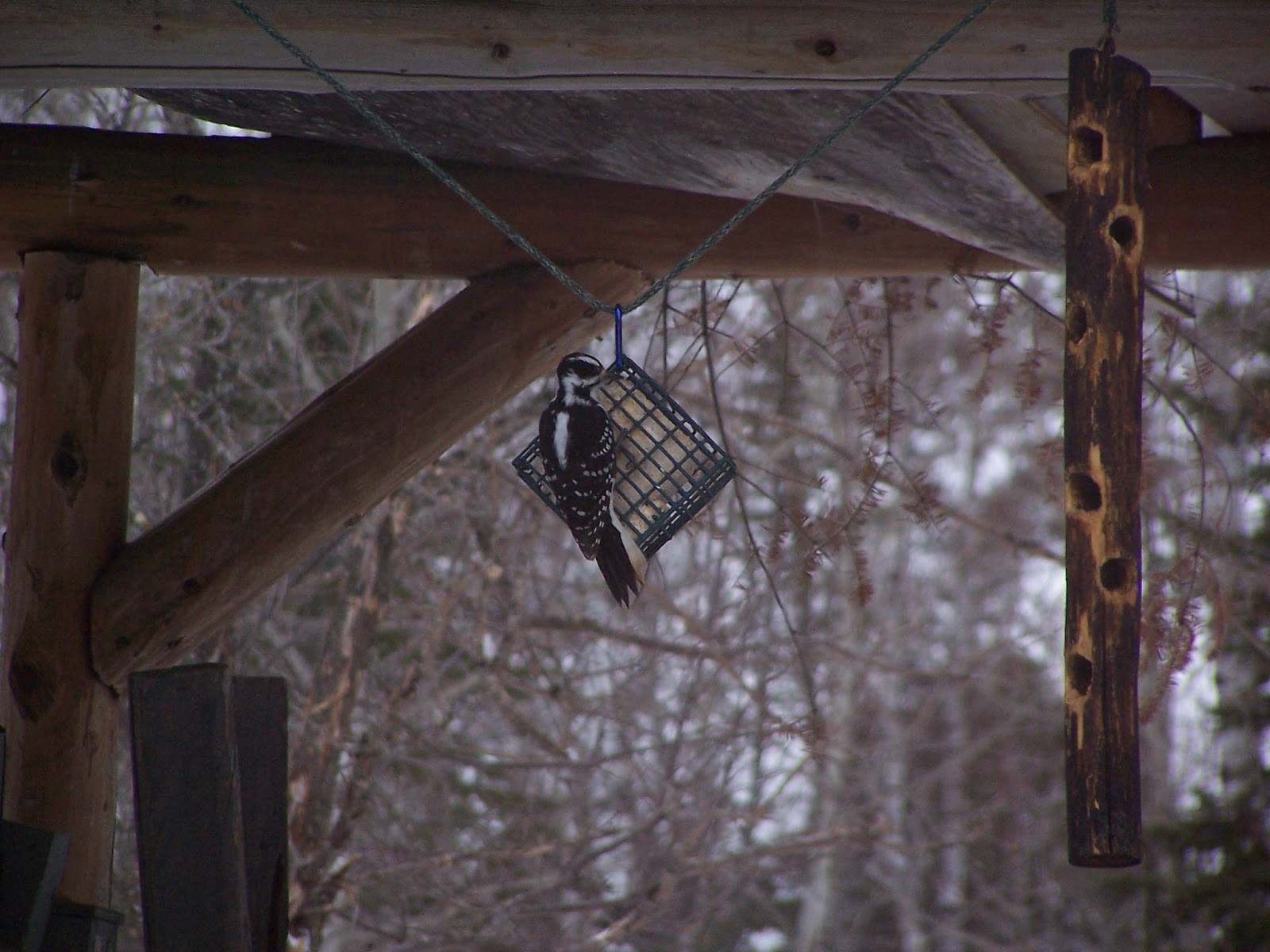
1. Body length - The Hairy Woodpecker is 9 - 9.25 inches in length, while the Downy Woodpecker is 6 - 6.75 inches in length according to The Sibley Guide to the Birds by David Allen Sibley, and the National Geographic Complete Birds of North America edited by Jonathan Alderfer.  The pictures below are of both species on the same suet feeder.

Hairy Woodpecker (Picoides villosus)
Downy Woodpecker (Picoides pubescens)


2. The Hairy Woodpecker has a longer bill, and the Downy Woodpecker has a shorter bill.  The Downy Woodpecker also has more bristles around the bill.  Think of the longer bird as having a longer bill.
Downy Woodpecker (Picoides pubescens)
Note shorter bill, and bristles at the base
of the bill.

Hairy Woodpecker (Picoides villosus)
with flying Black-capped Chickadee (Poecile atricapillus)
Note longer bill on woodpecker.
Hairy Woodpecker (Picoides villosus)
with Pine Siskins (Carduelis pinus)
Note lack of bristles at the base of the bill on the woodpecker.
 3. The Downy Woodpecker usually has dark bars out the outer tail feathers.  This is not always obvious.

4. The single note call of the Downy Woodpecker is "pick," and the single note call of the Hairy Woodpecker is "peek."  I think of it as the longer bird having the longer vowel.

5. The Downy Woodpecker often forages on smaller branches, and the Hairy Woodpecker often forages on larger branches.

Both types of woodpeckers are in this photograph.  The Downy Woodpecker (Picoides pubescens) is on the log feeder on the left, and the Hairy Woodpecker (Picoides villosus) is on the seed feeder on the right.